
Word Ladders: How to Go From “Stuck” to “Ohhh!” in Minutes
Word ladders look so innocent, don’t they? Two normal little words. A few blank lines. A cheery promise that you’ll simply “change one letter at a time.”
And then three moves in, you’re staring at something like CAG or DOH and questioning your education.
If you’ve ever gotten trapped in a word ladder spiral (same), here’s the good news: you don’t need a massive vocabulary or a Victorian era dictionary collection to get better. You just need a couple of smart habits that keep you from marching confidently into a dead end.
Let me show you how I actually solve these things without the emotional breakdown.
So… what is a word ladder, exactly?
A word ladder is where you transform a start word into an end word by changing one letter per step, and every step has to be a real word.
- Same word length the whole time (you can’t ladder from CAT to ELEPHANT, sorry)
- One letter changes, same position
- Every rung is a valid word
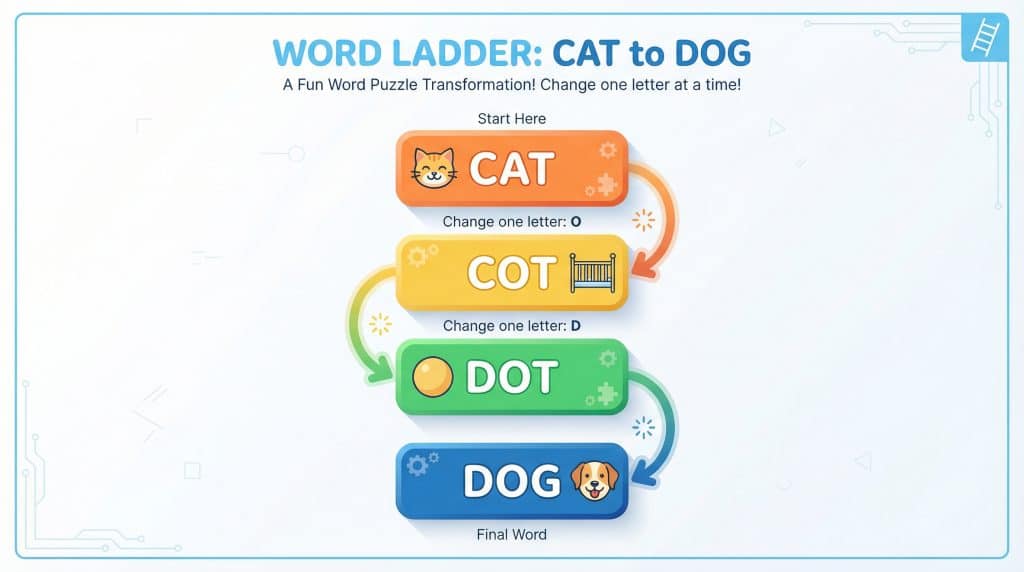
Classic example:
CAT → COT → COG → DOG
It’s simple in theory… which is exactly why it feels personally offensive when you can’t do one.
Also, word ladders go by a bunch of names Doublets (the original), Word Golf, laddergrams, change the word puzzles. Same brain itch, different label.
The tiny bit of history (because it’s actually fun)
These puzzles are old school. Lewis Carroll (yes, Alice in Wonderland Lewis Carroll) reportedly invented them as a Christmas time “please stop being bored in my house” activity for two kids in 1877.
And he basically described them as a form of verbal torture, which honestly valid.
He liked meaningful pairs too, like HEAD → TAIL or APE → MAN, which feels like the Victorian version of making everything a themed gallery wall. Extra? Yes. Memorable? Also yes.
The rules (aka the stuff that will get you disqualified in a competitive ladder off)
If you’re doing the classic version, these are the rules that matter for how Weaver is played:
- Change one letter per step.
No rearranging. No adding letters. No deleting letters. Just a swap. - Every rung must be a real word.
Not “it’s basically a word.” Not “my cousin says it’s a word.” A word. - Word length stays the same.
Four letters all the way through, five letters all the way through, etc. - No repeats.
If you loop back to a word you already used, you’re just walking in circles like you’re lost in IKEA. - Fewer steps is better.
Lots of ladders have multiple solutions. The cleanest one is the flex.
One quick decision that changes everything: what counts as a “real word”?
If you’re using a strict dictionary, you’ll have fewer options. If you’re using a Scrabble style word list, suddenly weird little gremlins like CHOKY can show up and save the day. (Or ruin it, depending on your personality.)
How I stop getting stuck: 5 tactics that actually work
1) Start from both ends (meet in the middle like a responsible adult)
Instead of marching forward blindly from the start word, do this:
- Make 1-2 moves from the start word
- Make 1-2 moves backward from the end word
- Look for overlap or a one letter away connection
It’s like digging a tunnel from both sides of a mountain. Less dramatic. More efficient. Fewer tantrums.
2) “Neighbor check” before you commit
When you’re stuck, don’t guess generate options.
Pick a letter position and cycle through the alphabet to see what real words exist.
Example with COLD (changing one letter at a time):
- Could you make CORD? Yes.
- COLT? Yes.
- COLD → GOLD? Also yes.
You’re basically making yourself a little menu of legal moves instead of panic ordering the first thing you see.
3) Use “bridge words” (the social butterflies of the dictionary)
Some words have a ton of one letter neighbors. They’re like that friend who knows everyone and somehow gets you into the VIP section.
These are often:
- short words
- common patterns (especially consonant vowel consonant like CAT, HAT, MAT, BAT)
If you can get into one of those big word families, you can usually hop around until an exit toward your target appears.
4) Watch your vowels vs. consonants
This is sneakily helpful: look at which positions need to switch from vowel → consonant or consonant → vowel.
Those switches tend to be harder because there are fewer “natural” intermediate words.
If you’re changing vowel to vowel (A → O) or consonant to consonant (T → D), it often goes smoother.
5) Take the “wrong” step on purpose
Sometimes the move that feels like it’s getting you closer… is the move that traps you.
If you have even one extra step to play with, use it to get into a better neighborhood of words, even if it looks like a detour.
Word ladders are less “straight line to the goal” and more “find a decent on ramp, then merge safely.”
A few ladders (so you can see the tactics in the wild)
Quick ones (confidence boosters)
- FLY → CRY
FLY → FRY → CRY - DOG → PIT
DOG → DOT → POT → PIT
These short ones are great for warming up your brain (like stretching before you try to move a sofa by yourself).
Medium (where patterns start showing up)
- HEAD → TAIL (a Carroll classic)
HEAD → HEAL → TEAL → TELL → TALL → TAIL - COLD → WARM
COLD → CORD → CARD → WARD → WARM
That last one works because of the little cluster around -ARD / -ARM. Once you land WARD, you can slide to WARM. Without that bridge word, you’re just flailing.
Longer (aka “why am I like this?”)
- FOOL → SAGE
FOOL → POOL → POLL → POLE → PALE → SALE → SAGE - WINTER → SUMMER
One option: WINTER → WINDER → WANDER → WARDER → HARDER → HARMER → HAMMER → HUMMER → SUMMER
Long ladders are where working from both ends really shines, because the number of possible branches gets wild fast.
Why some ladders feel impossible (because sometimes… they kind of are)
There’s this idea called Hamming distance, which is just the number of letter positions that differ between the two words.
Example: MAN and APE differ in all three spots, so the distance is 3. You’d think “cool, three steps.”
Nope.
A shortest path is actually:
MAN → MAT → OAT → OPT → APT → APE
That’s five steps, because English doesn’t give you convenient “straight line” words for the in between. The dictionary is like: “I hear your plan. I refuse.”
And sometimes, words are isolated enough that they barely connect at all. (Apparently ALOOF is famously lonely, which honestly tracks.)
So if you’ve ever spent 20 minutes trying to connect two words and felt like a failure: you might not be bad at word ladders. You might just be trying to build a bridge where there’s literally no landmass on the other side.
If you want to keep it interesting: a couple fun variations
If the classic rules start feeling tight (or you’re playing with kids, or you just like chaos), try:
- Word Golf: you and a friend solve the same ladder and compare “scores” (fewest moves wins). Friendly competition, mild trash talk encouraged.
- Clued word ladders: each rung has a definition clue, so it feels a bit crossword-y.
- Add/remove letter ladders: word length can change, which opens up a whole new world (and also makes your brain do squats).
When you’re really stuck (no shame): online helpers
I’m not above a hint. Sometimes I just want to learn what the missing bridge word was so I can store it in my brain for later like a squirrel with vocabulary acorns.
If you want a nudge:
- dCode.fr has a word ladder solver that can find shortest routes.
- There are also ladder solvers that show multiple paths or prioritize common words (helpful if you don’t want to “win” using a word nobody’s ever said out loud).
My personal rule: I’ll try for a while first, then use a tool to confirm I wasn’t trying to force a ladder through a brick wall.
Okay, your turn: try this without overthinking it
Pick two same length words (start with 3-4 letters), set a little timer for 5-10 minutes around the daily puzzle update schedule, and play. Don’t aim for perfection aim for progress.
And when you get stuck, don’t just stare harder. Do the things that actually help:
- work from both ends
- list your real “neighbor” words
- use a bridge word
- take a strategic detour
Because the whole magic of word ladders isn’t just “finding a path.” It’s that moment when the path suddenly clicks and you think, Ohhh, of course. (And then you immediately want to do another one, like a person who has forgotten the pain of the first ladder. Classic.)
Now go turn HATE into LOVE or COLD into HEAT and tell me you didn’t feel slightly powerful for a second.