
Ho-Oh vs. Lugia: The “Rivalry” That Literally Never Happens
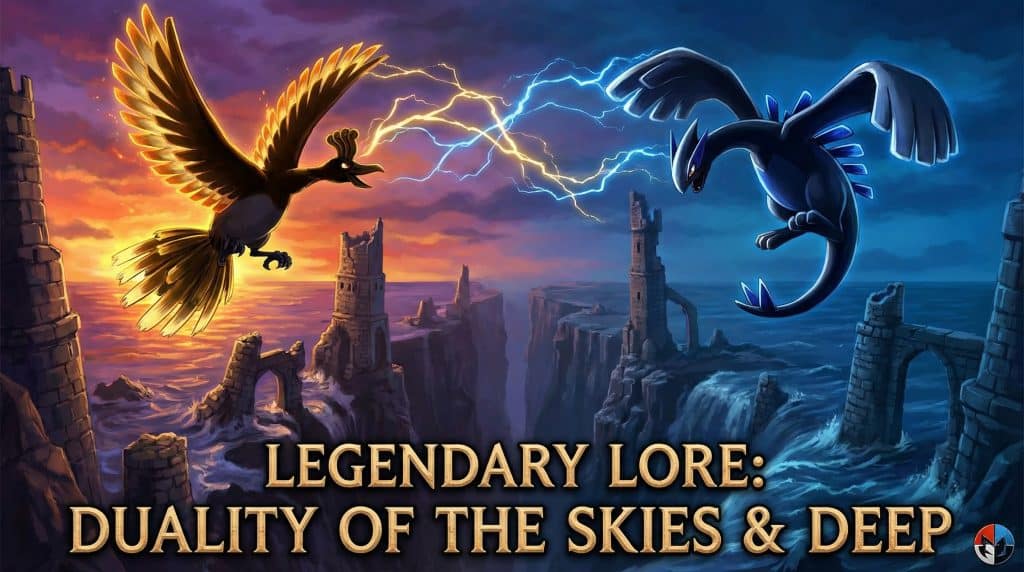
Somewhere along the way, Pokémon fandom collectively decided Ho-Oh and Lugia are mortal enemies.
And I get it. They’re the big fancy box legends of Gold and Silver. They’re perfectly “paired.” They’ve got the whole sky vs. sea, warm vs. cool, day vs. night vibe going on like a very dramatic scented candle set.
But here’s the thing that always makes me blink slowly at my screen:
In official game canon… Ho-Oh and Lugia do not fight. Not once. Not even a little “square up behind the Burned Tower at 3pm.” Nothing.
So if you’ve been waiting for some epic legendary cage match, I hate to be the bearer of bad news. The real story is quieter, sadder, and honestly way more interesting because it’s not about rivalry. It’s about separation, guilt, and two guardians reacting to the same disaster in completely opposite ways.
Let’s talk about what actually happened.
Why Everyone Thinks They’re Rivals (And Why That’s Not Really a Thing)
The “Ho-Oh vs. Lugia” idea mostly comes from a few very understandable assumptions:
- They’re version mascots, so they must be enemies.
Nope. That’s a game structure/marketing thing. The story treats them more like two guardians who got… emotionally divorced. - They’re designed as parallels (stats, placement, vibes).
True! But “paired” doesn’t automatically mean “punching each other.” Sometimes it just means “balanced like salt and pepper.” - Twin towers = twin rivals.
The towers matter, but the turning point isn’t “battle for dominance.” It’s catastrophe. - Legendary Beasts vs. Legendary Birds.
Ho-Oh’s connection to the Beasts is very game canon. Lugia being “boss of the birds” is mostly anime (hi, Pokémon 2000), where Lugia plays mediator, not warlord.
Also, quick nerd note before someone throws a Poké Ball at my head: when I say “canon” here, I’m talking mainline games + Pokédex + NPC dialogue. The anime is its own timeline. It can echo themes, but it doesn’t overwrite the games.
So if they’re not rivals… what are they?
Two forces keeping Johto livable by staying apart. Which is weirdly relatable if you’ve ever had to separate siblings in the back seat of a car.
They’re a Matched Set: Renewal vs. Restraint
Ho-Oh and Lugia are built like a mythological pairing. Ho-Oh screams “phoenix” rebirth, sacred fire, renewal, showing up in a blaze of glory to the chosen few. (It’s basically the legendary equivalent of a dramatic entrance.)
Lugia, on the other hand, is the “I have immense power and I’m going to remove myself from society so no one gets hurt” type. It’s not flashy. It’s heavy. It’s careful.
And yes, I know this drives some people nuts:
“Why isn’t Lugia Water type if it guards the sea??”
Because Lugia is not just a Psychic Flying legend “a big ocean bird.”
In the games, Lugia is Psychic/Flying on purpose for mind element design balance more like “primal force of nature” than “surf enthusiast.” The Pokédex goes out of its way to say things like a flap of its wings can blow houses away and it can trigger massive storms.
So Lugia living deep underwater isn’t aesthetic. It’s… damage control.
Ho-Oh is the opposite: Fire/Flying, signature move Sacred Fire, and it moves through the world. It appears to trainers it deems worthy. It’s active, selective, and honestly a little judgey (in a fun way).
This difference matters, because once upon a time, they did live near humans.
And then the worst thing happened.
The Brass Tower Fire: The Moment Everything Split
About 550 years before you roll into Johto with your starter and your hopeful little trainer dreams, both legends were tied to Ecruteak City.
- Ho-Oh roosted at what we now call the Bell Tower.
- Lugia stayed in the Brass Tower, right across from it.
Two towers. Two guardians. One city.
Then lightning struck the Brass Tower, and it caught fire.
The fire burned for three days, and three Pokémon died inside.
Now here’s the part that feels like the whole emotional thesis statement of Johto:
- Ho-Oh responded with creation.
- Lugia responded with exile.
Ho-Oh: “Life out of ash.”
Ho-Oh descended to the ruins and revived those three fallen Pokémon into Raikou, Entei, and Suicune the Legendary Beasts, each tied to an element of the disaster (lightning, fire, rain).
That is peak phoenix energy. Tragedy happens, and Ho-Oh says, “Okay. We rebuild. We transform. We make something sacred from something awful.”
Lugia: “Even my help can destroy you.”
Lugia tried to help, too but it’s complicated.
Depending on how you interpret the lore, Lugia’s power (wind, storms, rain) is so intense that trying to interfere around humans is risky. Think “calling the fire department” except the fire department is a living hurricane.
And after the Brass Tower burned, Lugia basically went, “I can’t stay here. Even when I try to help, I might make it worse.”
So Lugia left Ecruteak behind and went to the sea eventually settling around the Whirl Islands.
And the Brass Tower? It becomes the Burned Tower, still standing like a big charred reminder that legendary power + human proximity is a fragile, flammable combo.
This isn’t rivalry. It’s trauma.
The Trio Connections (AKA: Why One Feels Like a “Boss” and the Other Feels Like a “Guardian”)
Ho-Oh’s trio link is clean and game canon:
- Ho-Oh created the Legendary Beasts (revived them into what they are now).
- The Beasts reflect the fire’s lightning, flames, and rain.
Lugia’s trio situation is messier, because the famous “Lugia and the birds” thing is mostly popularized by the anime. And in that story, Lugia isn’t their creator it’s the adult in the room trying to stop Articuno, Zapdos, and Moltres from turning the region into a weather apocalypse.
So if you’re trying to summarize their “roles” in one line:
- Ho-Oh = creator/renewal.
- Lugia = keeper/restraint.
And that difference shows up again in the way each one decides whether humans deserve to see them again.
What Brings Them Back (And What That Says About Them)
This is my favorite part, because it’s basically their philosophies in two sentences.
Ho-Oh comes back for one exceptional person.
Ho-Oh returns when a trainer appears who can “touch the souls of Pokémon.”
That is very Ho-Oh. It’s like, “Show me one person with a rare bond and a good heart, and I’ll show up.”
Hopeful. Individual. A little fairytale.
Lugia comes back when people get their act together.
Lugia’s return conditions are more like: “Cool, you’re pure of heart… but also, has the trust between humans and Pokémon returned?”
In other words: one good egg isn’t enough. Lugia wants broader repair, not just one shining hero moment.
And honestly? That tracks. Lugia is the legendary that watched a city burn and learned, the hard way, that even “help” can be destructive if the world around you isn’t ready for it.
Ho-Oh believes in the power of the rare individual. Lugia believes in the need for collective change.
Neither is wrong. They’re just… shaped by the same tragedy in opposite directions.
The Games Actually Reinforce This (Which Is Why the “Rival” Thing Feels So Off)
This is where the version split is actually kind of brilliant.
In Gold/Silver and later remakes, you’re nudged into meeting one guardian first your version’s guardian before you can properly encounter the other.
It mirrors the lore: they’re connected by history, but separated in practice. You don’t stroll into Johto and collect both like matching throw pillows.
And in Crystal, the game leans even harder into Ho-Oh’s role with the Legendary Beasts: you need those Beasts caught before Ho-Oh will appear. That’s not subtle. That’s the game turning the backstory into an actual rule you have to live with.
So, no Game Freak didn’t “forget” to write the part where they fight.
The whole point is that they don’t.
The Real Reason They Don’t Fight: Distance Is the Safety Plan
If Ho-Oh and Lugia have a “relationship status,” it’s not “enemies.”
It’s: “Do not stand too close together or everything goes sideways.”
Ho-Oh brings renewal, fire, big change energy. Lugia brings storms, restraint, and power so massive it has to be buried under miles of water.
Put them both in the same place, under the wrong circumstances, and you’re not getting harmony you’re getting a region scale disaster smoothie.
So their separation isn’t a narrative hole. It’s the balance.
Ho-Oh in the sky. Lugia in the deep. Humans living in the narrow band between, hopefully not doing anything too Team Rocket about it.
So… What Are Ho-Oh and Lugia, If Not Rivals?
They’re two guardians tied to the same city, the same catastrophe, and the same responsibility protecting a world that can’t really handle them.
Ho-Oh chooses hope in individuals. Lugia chooses caution for the whole.
And the reason you keep “missing” the big legendary showdown is because the story isn’t about a fight. It’s about what happens after the fire: creation vs. withdrawal, faith vs. restraint, closeness vs. distance.
Next time you climb the Bell Tower or slog through the Whirl Islands (affectionate), don’t look for rivalry.
Look for the scar tissue.
Because Johto’s legends aren’t separated because they hate each other.
They’re separated because that’s how Johto survives.