
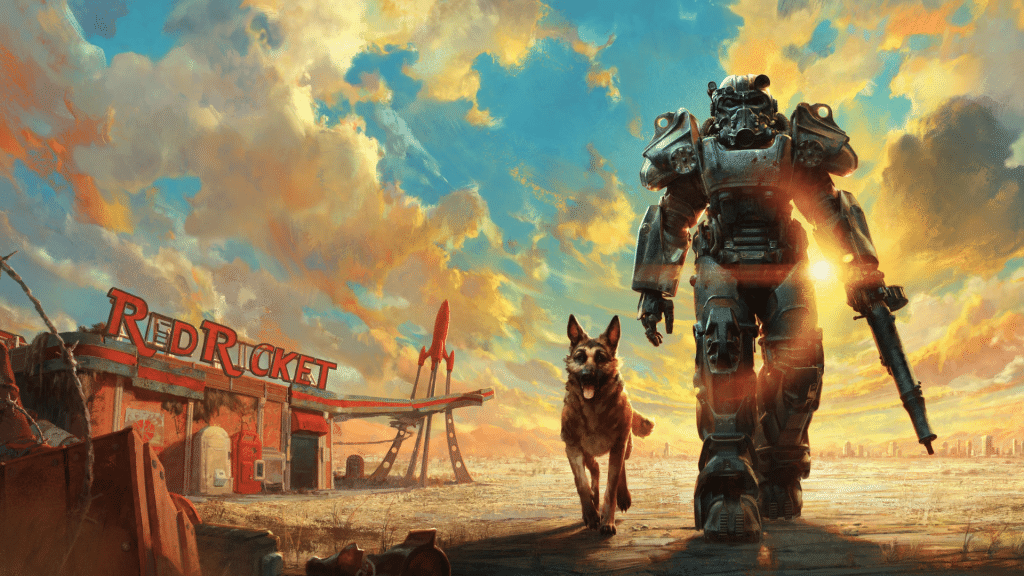
When I look back at Fallout 4 and the reactions it received from major gaming publications, I’m reminded of how divided the community and critics were when it launched.
I remember being drawn in by the massive open world and the freedom to explore every corner of post-apocalyptic Boston.
The blend of improved gunplay, deep crafting, and settlement building excited many players, yet the simplified dialogue system and reduced RPG depth frustrated longtime fans.
In this review breakdown, I wanted to revisit what critics genuinely loved about Fallout 4, and what they felt held it back.
So anyone revisiting the game today can understand how it earned such a mixed but memorable legacy.
Why Fallout 4 Remains a Major Review Topic
Fallout 4 remains a major topic of review because it represents a pivotal moment in the evolution of open-world RPG design.
Critics and players still reference the game for its ambitious blend of action-oriented combat, exploration-heavy worldbuilding, and streamlined RPG systems.
Its shift toward shooter mechanics and simplified dialogue sparked ongoing debate about the balance between accessibility and depth in modern RPGs.
Fallout 4’s community also keeps the game relevant, as thousands of user-created enhancements extend its lifespan and influence discussions of long-term game support.
Additionally, comparisons to Fallout 3 and Fallout: New Vegas maintain critical interest, since Fallout 4 occupies a middle ground between narrative-driven design and sandbox gameplay.
As new Fallout projects emerge, critics continue revisiting Fallout 4 to evaluate its lasting impact and its place within the franchise’s legacy.
Reviews From Top Gaming Sites
Expert reviews from major gaming publications offer a clear picture of Fallout 4’s strengths and weaknesses. These highlight what worked, what didn’t, and how the game has evolved over time.
1. IGN
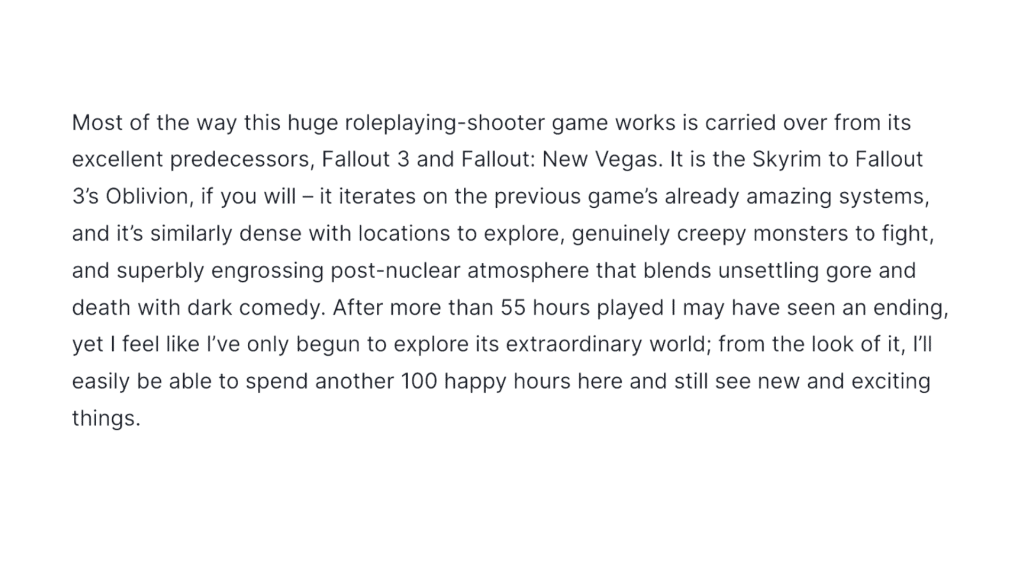
IGN highlights how Fallout 4 builds on the foundations of its predecessors, offering a dense world filled with atmospheric locations and a blend of dark humor and grim, post-nuclear storytelling.
The review emphasizes how the game encourages deep exploration, noting that even after dozens of hours, new areas, quests, and discoveries continue to appear.
IGN also compares Fallout 4’s design leap to the jump between Oblivion and Skyrim, describing it as a refined and expanded version of what came before.
Overall, the review portrays Fallout 4 as a vast, engaging experience that keeps players invested for well over 100 hours.
2. GameSpot
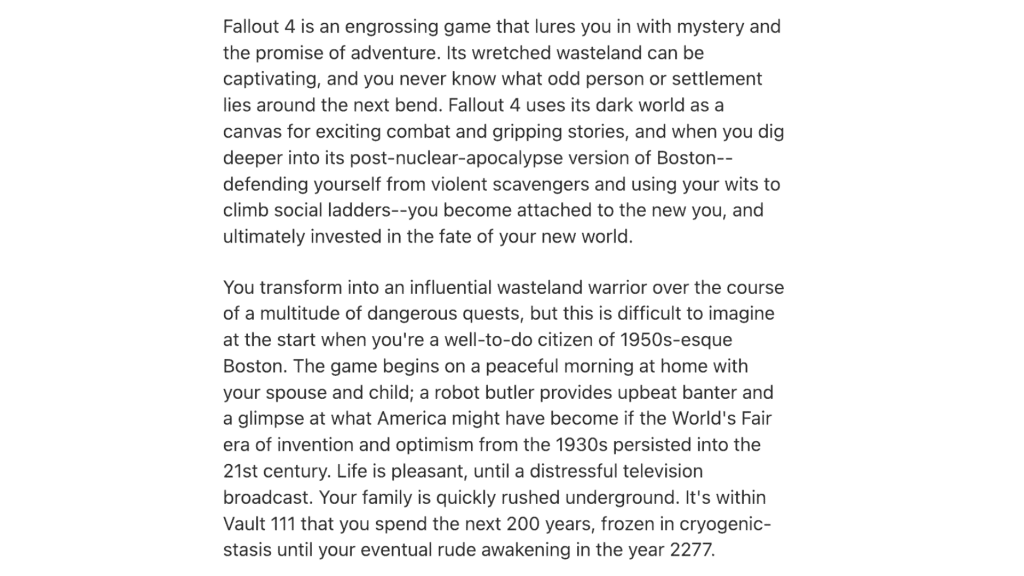
GameSpot describes how the wasteland constantly pulls players forward with unexpected encounters, unique settlements, and a world filled with danger and opportunity.
The review emphasizes the contrast between the peaceful pre-war opening and the harsh reality that follows.
Highlights how the narrative transitions from domestic calm to a desperate struggle for survival in Vault 111.
GameSpot notes that the journey from an ordinary citizen to an influential figure in the wasteland is driven by combat, choice, and personal growth.
3. Polygon
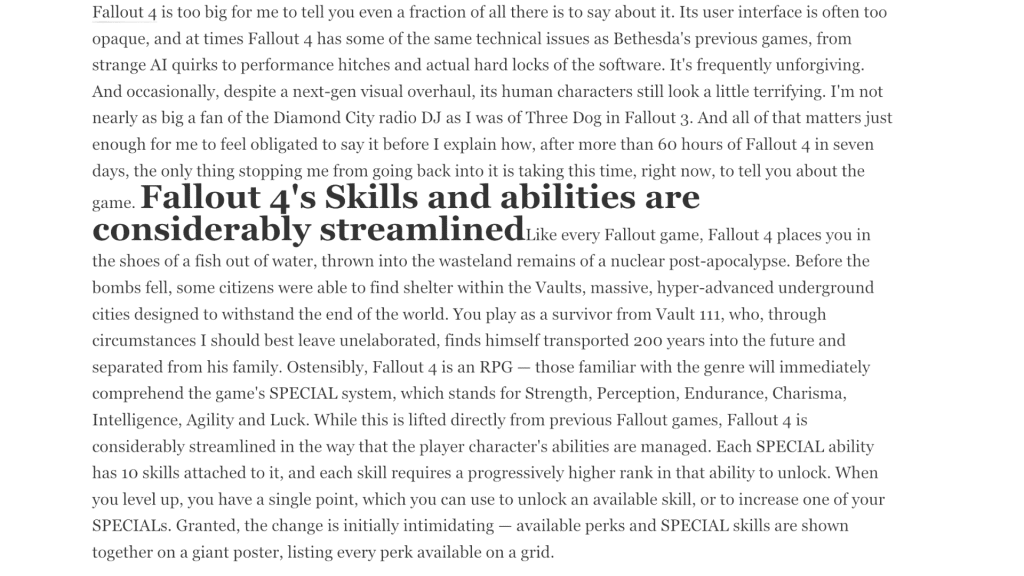
Polygon acknowledges the game’s flaws, including its at-times confusing interface, familiar Bethesda technical issues, inconsistent character models, and uneven presentation.
Yet the review also highlights how those concerns ultimately matter less than the sheer pull of the experience.
Polygon emphasizes that Fallout 4 combines streamlined RPG systems with the familiar SPECIAL progression, offering a more accessible, but initially overwhelming approach to perks.
Despite imperfections, Polygon frames Fallout 4 as an absorbing game that continually draws players back in.
4. Kotaku
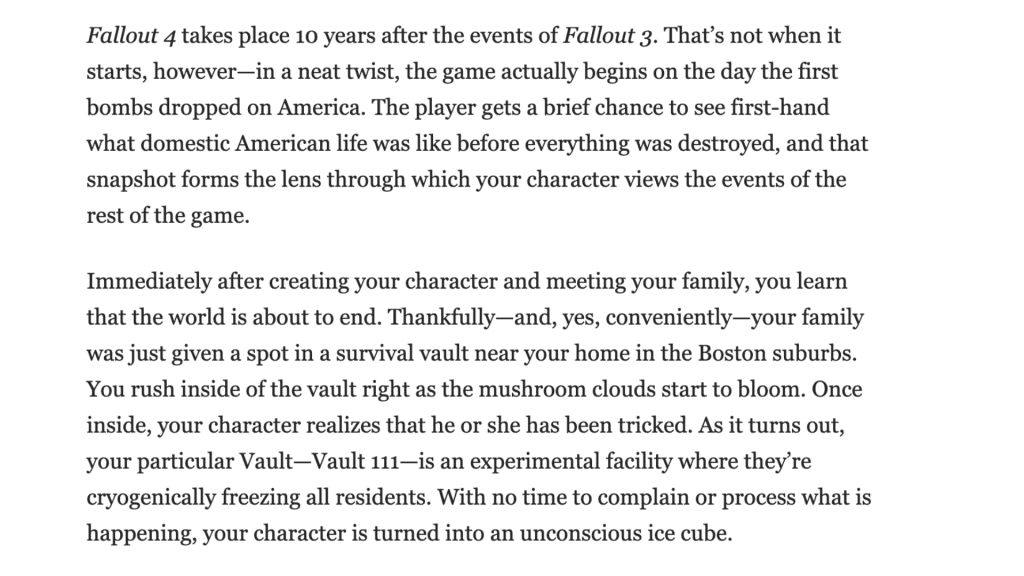
From what I found in Kotaku’s review of Fallout 4, the story’s opening is one of the game’s strongest elements, setting it apart from previous Fallout entries.
Kotaku highlights how the game begins not in the wasteland, but on the day the bombs fall, giving players a rare glimpse of pre-war American life.
The review emphasizes how quickly this calm is broken, leading to a frantic escape into Vault 111 as nuclear destruction unfolds overhead.
Kotaku explains that the vault itself is not the safe haven it appears to be; it’s actually a cryogenic experiment that traps the protagonist in suspended animation.
5. Game Informer
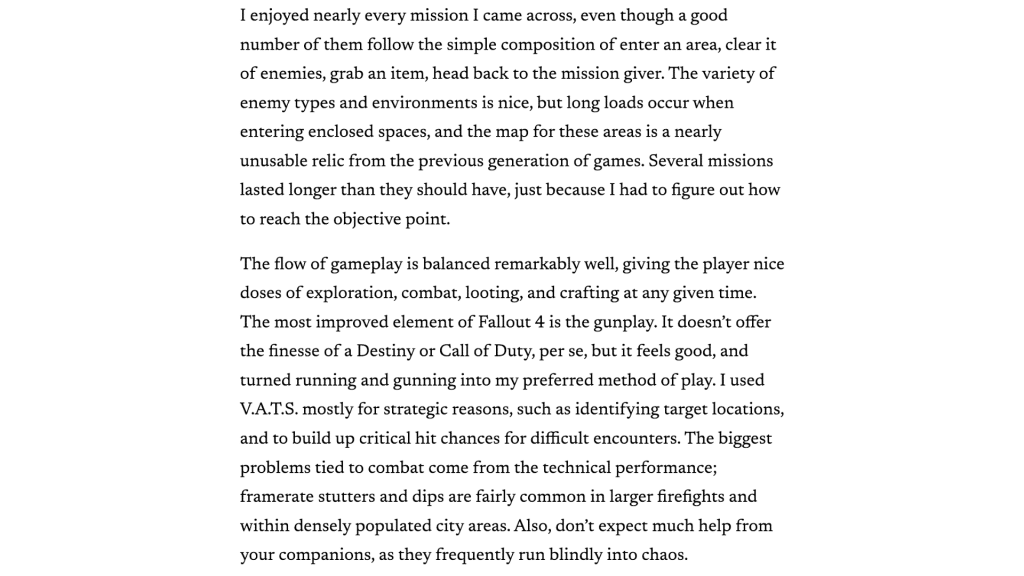
The review points out that while many quests revolve around clearing areas and retrieving items, the variety of enemies and environments keeps the experience engaging.
Game Informer does note some frustrations, including long loading screens when entering interior spaces and a clunky map system that can make navigation confusing.
The review highlights how well the core gameplay loop balances exploration, combat, crafting, and looting.
Gunplay is called one of the most significant improvements, offering satisfying action even if it lacks the finesse of more polished shooters.
6. Games Radar

GamesRadar praises the sheer scale of the world, emphasizing how the open-world design encourages endless exploration and creativity.
The review highlights the colorful visual update and the noticeably improved combat, noting that these upgrades make the moment-to-moment gameplay more exciting than in past Fallout titles.
GamesRadar points out that the high system requirements can make crafting slow and that framerate performance can be inconsistent in certain areas.
Overall, the impression from GamesRadar is that Fallout 4 is huge, ambitious, and rewarding, despite a few performance issues, offering an expansive RPG experience..
Breakdown of Positive Reviews
Critics widely praised the detailed recreation of post-apocalyptic Boston, noting how its environmental storytelling encourages exploration and rewards curiosity.
The improved gunplay received frequent commendation, with many reviewers describing it as more responsive and enjoyable than in previous Fallout titles.
The crafting and settlement-building systems were also regarded as innovative additions, giving players new ways to personalize their experience and shape the wasteland around them.
Companions, varied quests, and the blend of dark humor and emotional narrative moments further contributed to favorable impressions.
Reviewers emphasized how the world feels alive through its factions, secrets, and unexpected encounters, making lengthy playthroughs engaging.
Overall, positive critiques focused on Fallout 4’s ability to deliver immersion, freedom, and long-lasting entertainment.
Breakdown of Negative Reviews
Critics frequently point out that the game suffers from familiar Bethesda issues, including performance drops, stiff animations, and occasional bugs that disrupt immersion.
The revised dialogue system, which reduces conversational options and player agency, is one of the most common complaints.
The RPG elements, such as character customization and skill progression, were also criticized for feeling less sophisticated than in Fallout: New Vegas.
Some critics found the mission structure repetitive, particularly in faction quests with similar objectives.
Despite its strengths, Fallout 4’s negative critiques emphasize how technical quirks and design streamlining diminish the depth some fans expected.
Why Compare Expert Reviews?
When I compare expert reviews of Fallout 4, I gain a clearer understanding of how the game truly resonated across different types of critics.
Each publication focuses on different strengths and weaknesses, so looking at multiple perspectives helps me form a more balanced and informed opinion.
Some reviewers highlight the incredible open-world design and improved combat, while others emphasize the shortcomings of the dialogue system or technical issues.
By examining these viewpoints side by side, I can see where critics agree, where they differ, and why Fallout 4 remains such a debated entry in the franchise.
Comparing expert reviews also reveals how expectations have changed over time, giving me a better sense of the game’s legacy.
Ultimately, it helps me appreciate Fallout 4’s achievements while understanding the valid concerns raised by long-time fans and professional reviewers alike.
Conclusion
After going through a wide range of expert reviews, I’ve come to appreciate just how complex and polarizing Fallout 4 truly is.
The game delivers an unforgettable world, exciting combat, and endless opportunities for exploration, and many critics praised it for those strengths.
At the same time, I understand why others were disappointed by the simplified RPG systems, technical issues, and changes to dialogue and player choice.
Comparing these perspectives helped me see the game in a more complete way, recognizing both its huge ambitions and its flaws.
For anyone revisiting Fallout 4 or trying it for the first time, understanding these varied critiques makes the experience richer and sets the right expectations.