
Psychic Pokémon: The Design Secrets Most Trainers Miss (and Why They’re Always a Little Weird)
I have a confession: I’m the kind of person who can spot a Psychic type in the wild before the Pokédex even finishes its little beep boop routine. Not because I’m gifted (tragically), but because Game Freak has been slipping us the same visual and story clues for decades.
Psychic types aren’t just “the ones that shoot purple beams.” They’re a whole vibe—rare on purpose, frequently busted by accident (hi, Gen I), and almost always designed to feel like they know something you don’t. Which is… honestly rude? But also iconic.
So let’s talk about what makes a Pokémon “Psychic,” why the type has this legendary aura (sometimes literally), and how to actually use them without getting swatted like a mosquito by a random Crunch.
First: What “Psychic” Actually Means (It’s Not Just Sparkles)
At the core, Psychic is mind over matter. Telekinesis. Telepathy. Reality bending. “I lifted a spoon with my brain and now I’m going to ruin your day.” That’s the assignment.
And this is the part people miss: a Pokémon can be mystical without being Psychic. Fire is still fire. Electricity is still electricity. Water is still water. Psychic is when the mind is the weapon.
If a Pokémon:
- floats like gravity is optional,
- communicates without speaking,
- warps space/time/dimensions/your confidence,
- or just looks like it’s halfway phased out of reality…
…it’s probably Psychic (or at least Psychic adjacent). And yes, sometimes the design is basically “big eyes + aura + загадочный vibes.” It works, okay.
The Time Psychic Types Accidentally Became Untouchable (Gen I Was a Mess)
If you ever hear older fans speak about Gen I Psychic types the way people talk about a mythical golden era, it’s because Psychic wasn’t just strong—it was functionally unfair.
The game intended Ghost to counter Psychic. But thanks to a lovely little coding/interaction issue, Ghost moves didn’t properly do the job. Meanwhile:
- Bug had basically no good moves (sorry, Bugs),
- the main Ghost line was Gengar… which is also Poison… which Psychic eats for breakfast,
- and Psychic’s best tools were everywhere.
So you got this era where Alakazam and friends strolled through Kanto like they owned the place. Because… they kind of did.
Gen II: The Great “Okay, Never Again” Balance Patch
Then Gen II rolled in like a tired parent who just found marker on the walls and said, “Alright. New rules.”
Game Freak fixed Psychic’s reign in a few big ways:
- Dark type showed up and said, “Your mind tricks don’t work on me,” with a full on immunity.
- Steel type entered the chat with a resistance.
- Ghost started behaving more like an actual counter.
- And a bunch of mechanics shifted so Psychics weren’t automatically bulky special tanks forever.
The result? Psychic stopped being the universal answer and became what it is now: a high power specialist that needs backup and good planning. (Which, honestly, is more interesting—less “press Psychic and win,” more “do I risk this switch or am I about to get folded.”)
Why So Many Legendaries Are Psychic (Because Psychic = “Cosmic Big Deal”)
Have you noticed how often Psychic gets slapped onto Legendaries and mythicals?
Mewtwo. Lugia Psychic Flying rationale. The Lake Trio. Solgaleo. And a bunch of others that just radiate “ancient knowledge” or “I live between dimensions” energy.
Psychic typing is Game Freak’s shorthand for:
- higher intelligence,
- mystery and perception,
- and power that feels… unearned by muscles.
And they keep the type comparatively rare (especially compared to mega common types like Water) so it doesn’t lose that “special” factor. Psychic is supposed to feel like the Pokémon equivalent of finding a secret room behind a bookshelf.
Also: the lore often builds in limits. Like Jirachi—absurd power, but it conks out and needs a 1,000 year nap. Which is relatable, honestly.
How to Recognize a Psychic Type Before the Game Tells You
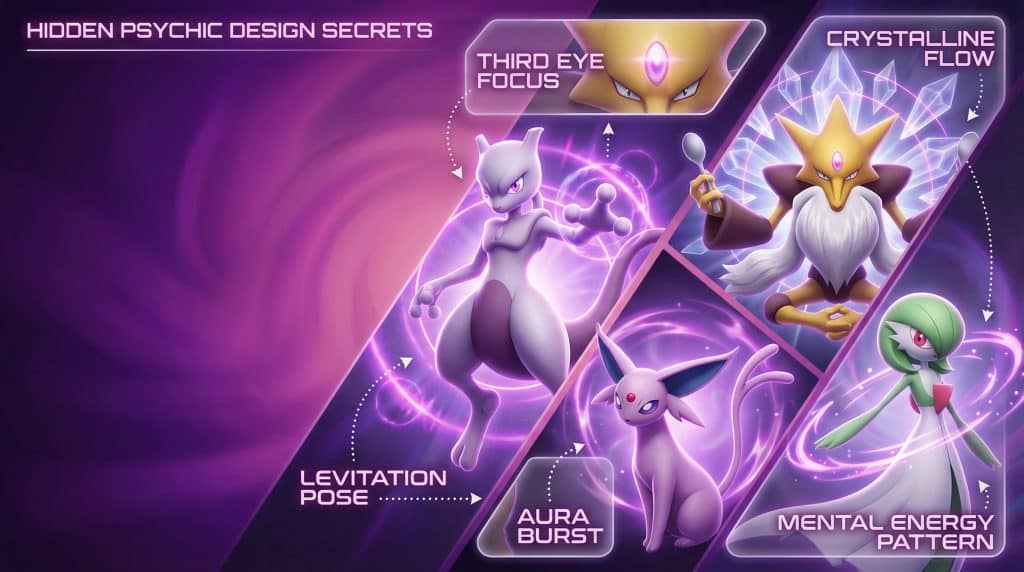
If you want to start “reading” typings, Psychic has some of the most consistent design tells in the franchise. Here are the big ones I look for:
1) The “Esper” (aka “Human-ish = Brainy”)
Humanoid silhouettes are a classic cue: Alakazam, Gardevoir, Gothitelle. Even before they move, they look like they solve problems with their minds, not their fists.
2) The “Cosmic Floaty Baby”
Mew is the poster child here. Small, simple body… but it never feels fully grounded. Floating reads like “not bound by physics,” and Psychic types love flirting with physics like it’s a casual suggestion.
3) The “Alien Anatomy”
Elgyem and similar designs go for unsettling symmetry, weird limbs, odd proportions—like the artist is saying, “This thing’s brain is not running the same operating system as yours.”
4) The “Enchanted Object”
Sometimes the power is in an item or artifact (like armor infused with psychic energy). That’s not “technology type,” it’s “cursed/blessed/supernaturally charged.”
Bonus visual tells I swear by:
- Eye emphasis (big eyes, too many eyes, “I see your thoughts” eyes)
- Auras and glow effects
- Floating parts or constant levitation
- Colors like purples/pinks help—but aren’t required
Basically, if it looks like it could politely move your keys without standing up, consider Psychic.
Matchups: Psychic Is a Scalpel, Not a Sledgehammer
Psychic’s strengths and weaknesses make a lot more sense when you treat the type like precision mental power, not generic “magic.”
Psychic hits:
- Fighting (mind beats muscle—classic)
- Poison (control over the body, toxins, etc.)
Psychic fears:
- Dark (dirty tricks, obscured intent—your big brain prediction game gets wrecked)
- Ghost (the unknown/uncanny slipping past mental defenses)
- Bug (chaos, swarming, phobias—yes, really)
Also: Psychic doesn’t get a bunch of comfy resistances or cute immunities. You don’t pick a Psychic type to be your emotional support wall. You pick it to hit hard, outspeed, or do something annoying and clever.
Dual Typing: How Psychic Sneaks In Without Taking Over
Something I love once you notice it: a lot of Psychic Pokémon are dual type, and Psychic is often the secondary type.
Translation: the Pokémon’s “main identity” is something else, and Psychic is the little tag that says, “BTW, this one is different. It’s got brain stuff going on.”
And strategically, dual typing can patch Psychic’s biggest problem (getting deleted):
- Psychic/Fairy can soften the Dark/Bug misery in certain matchups.
- Psychic/Steel adds a pile of useful resistances and a Poison immunity.
- Psychic/Dark leans into the “mind games but make it shady” archetype.
Pure Psychic can absolutely work, but it’s often a “high risk, high reward” life choice.
The Psychic Trade: Big Damage, Fragile Feelings
If Psychic types had a slogan, it would be: “I can delete you, but please don’t touch me.”
Many of them are built like special attackers with speed… and then defenses that feel like wet cardboard (said with love). Alakazam is the obvious example: terrifying Special Attack and Speed, and then a stiff breeze on the physical side.
So if you’re running Psychic types, you usually want at least one of these:
- speed (hit first),
- a safe switch (pivot moves, resistances, screens),
- or positioning tools (terrain, redirection in doubles, etc.).
Because if you just toss your Psychic in raw and hope for the best… the best will not happen.
Modern Psychic “Cheat Codes” (Terrain, Items, and Tera Shenanigans)
Newer gens gave Psychic types some genuinely spicy tools, and I am grateful because I enjoy winning.
Psychic Terrain
- Boosts Psychic moves by 30% for grounded Pokémon.
- Blocks priority moves from hitting grounded Pokémon (which is huge—no getting sucker punched by priority the moment you show your face).
- In doubles, Expanding Force becomes a whole event under Psychic Terrain.
Held items that quietly add up
Things like Twisted Spoon, Mind Plate, and Odd Incense give a flat boost (typically 20%) to Psychic type moves. These stack with other modifiers, so the damage can get silly fast if you build around it.
Terastallization (Gen IX)
Tera lets a Pokémon change its type once per battle, and it stays that way until it faints (no, not three turns—this isn’t a rental car situation). Going Tera Psychic can:
- supercharge Psychic STAB damage,
- flip your defensive profile,
- and turn “I’m about to lose” into “surprise, I’m the problem now.”
Psychic still has hard counters—Dark types don’t suddenly start respecting your feelings—but modern mechanics give you more ways to set the terms of the fight.
So… Should You Use Psychic Types?
If you like fast, clever, slightly dramatic Pokémon that feel like they’re playing chess while everyone else is throwing rocks, Psychic types are absolutely your people.
Just remember the deal: you get power and utility, but you also get weaknesses that punish sloppy positioning. Play them like precision tools—bring support, pick your moments, and don’t act shocked when a sneaky Dark type ruins your montage.
And next time you see a floating creature with weird anatomy and “I know your search history” eyes… trust your gut. That’s probably Psychic. Or it’s about to be.