

The deep regrets board game pulls you into risky fishing choices where every catch can help you win or quietly cause problems later.
I have seen players laugh, stress, and rethink plans fast because each turn mixes smart planning with hidden consequences you cannot ignore.
This game blends dice rolls, card effects, and rising madness while players balance money, energy, and tough decisions across several in-game days.
You may be wondering if the rules are hard, how regret works, or whether the game feels fair when luck enters the picture.
I will be telling you about gameplay flow, setup basics, scoring rules, regret mechanics, and common mistakes so you can play with confidence.
Keep reading and see how this game works, what to expect at the table, and how to avoid losing to regret alone.
What is the Deep Regrets Board Game About?
Deep Regrets is a horror fishing board game where 2 to 5 players take the role of troubled anglers chasing profit while strange things creep closer each day.
It works best with 2 to 4 players and is suitable for ages 16 and up due to dark themes and tough choices.
The game plays across 6 in-game days from Monday to Saturday, with each player’s turn lasting about 30 minutes overall.
You roll special tackle dice to decide actions, then choose between fishing in dangerous waters or visiting a port to sell fish and recover energy.
Every choice slowly adds hidden Regret cards that boost power through madness, but punish the player holding the most at the end.
It feels tense, slightly funny, and stressful in a good way, like pushing luck too far and knowing something bad might bite back.
Deep Regrets Board Game Components And Box Contents
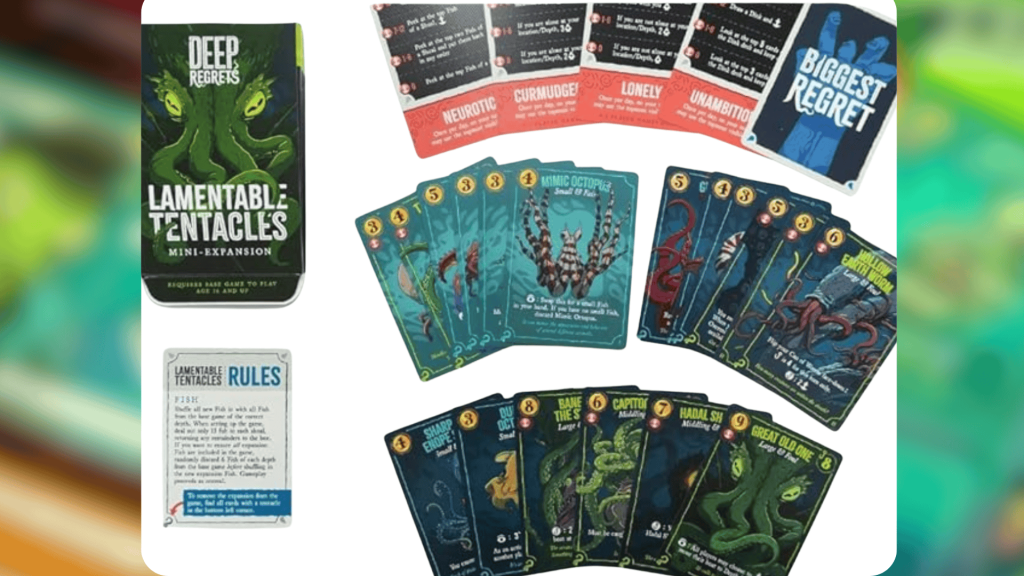
The Deep Regrets box gives players everything needed to play without extras, focusing on strong table presence and clear pieces.
Most parts are made from wood and paper materials, so the game feels solid while avoiding plastic parts during long play sessions.
- You get a large sea board, a port board, and 5 player boards that track money, energy, mounts, and madness.
- The box includes many fish cards, regret cards, tackle decks, reference cards, and trackers used to manage days, dice, and actions.
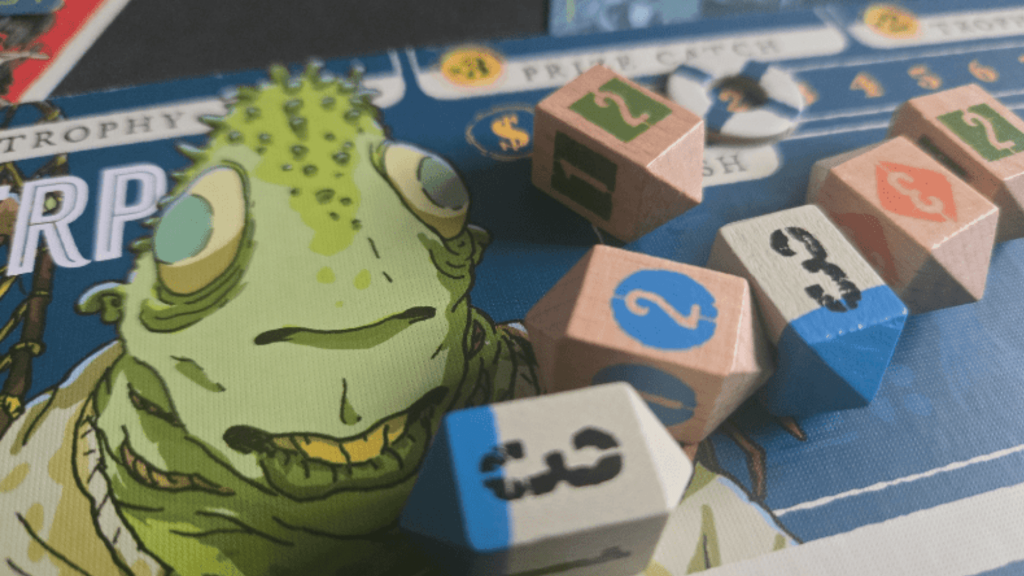
- Wooden dice, player pieces, and coins handle all rolls, movement, and buying without needing screens, apps, or extra tools during play time.
Everything fits back into the box neatly, making setup and cleanup quick for solo players or full group sessions at the table.
How To Set Up the Deep Regrets Board Game?
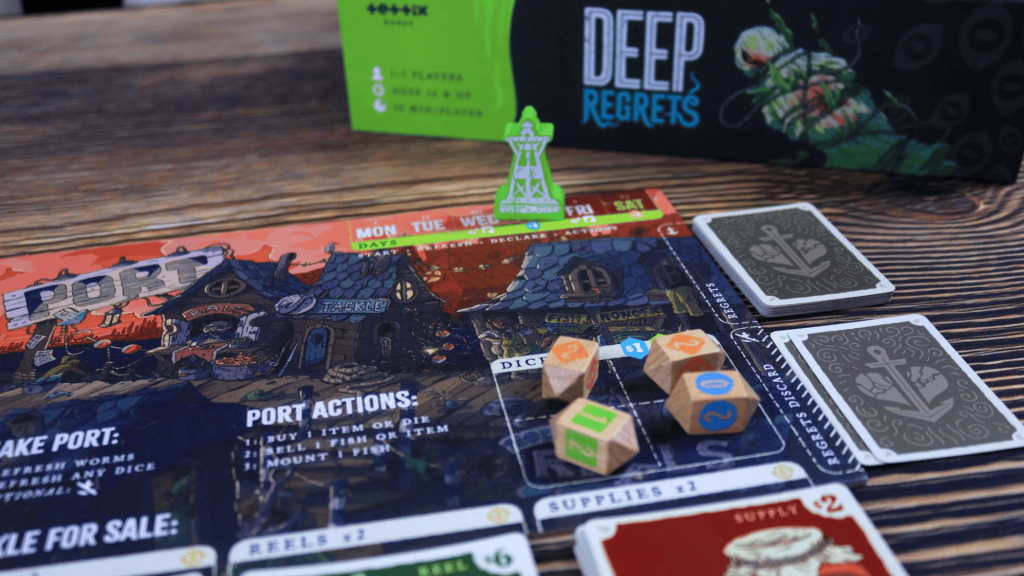
Setting up Deep Regrets is quick and usually takes about 5 minutes once everyone knows the flow.
Place the sea board in the center, keep the port board nearby, shuffle fish cards by depth, and set the day tracker to Monday.
Each player takes a player board, places their marker at the port, sets energy full, madness at 0, and fishbucks at 0. Give every player 3 starting dice, reference cards, a lifeboat card, and a can of worms card face up.
Draw tackle dice into the market, place regret cards nearby, and set the rod, reel, and supply decks near the port.
Do a quick check that no fish are revealed early, then choose a starting player, and you are ready to begin.
How Does Gameplay Work in Deep Regrets Board Game?
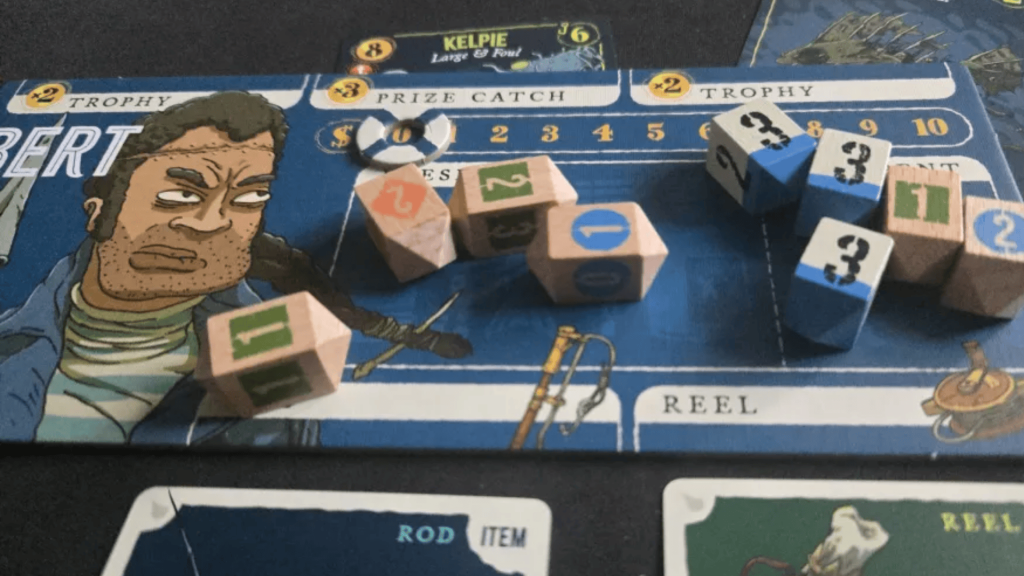
Players secretly choose where to act, spend dice to perform actions, and manage energy, money, and rising madness carefully.
1. How Does a Player Turn Work?
At the start of a turn, the active player rolls all available dice and places them into the fresh area on their player board.
Each player begins with 3 dice, and every madness level adds 1 extra die, increasing choices while also raising later penalties.
If the player’s energy is not at maximum, they gain exactly 1 energy before making any decisions or spending dice.
This step only prepares dice and energy. No actions are taken during this part of the turn.
2. Main Actions Players Can Take
After preparation, each player chooses to go to sea or stay at port, then begins spending dice to perform allowed actions.
Dice are spent one at a time, and once used, they move from the fresh area to the spent area on the board.
At sea, dice are used to attempt fishing, flip fish cards, and resolve any effects printed on those cards. At port, dice are used to sell fish, buy gear, mount fish, or recharge energy for later turns.
A player may also choose to pass, which immediately ends their turn and provides a small benefit.
3. How does the Turn End and the Day Move Forward?
A player’s turn ends when they choose to pass or when they no longer have any usable dice remaining.
After a turn ends, play moves clockwise to the next player without resolving any extra steps between turns. Once all players complete their turns, the day tracker advances forward by 1 space on the shared board.
Any required refresh steps happen before the next day begins.
The game continues until the final day is completed.
How Regret And Risk Mechanics Work In Deep Regrets?
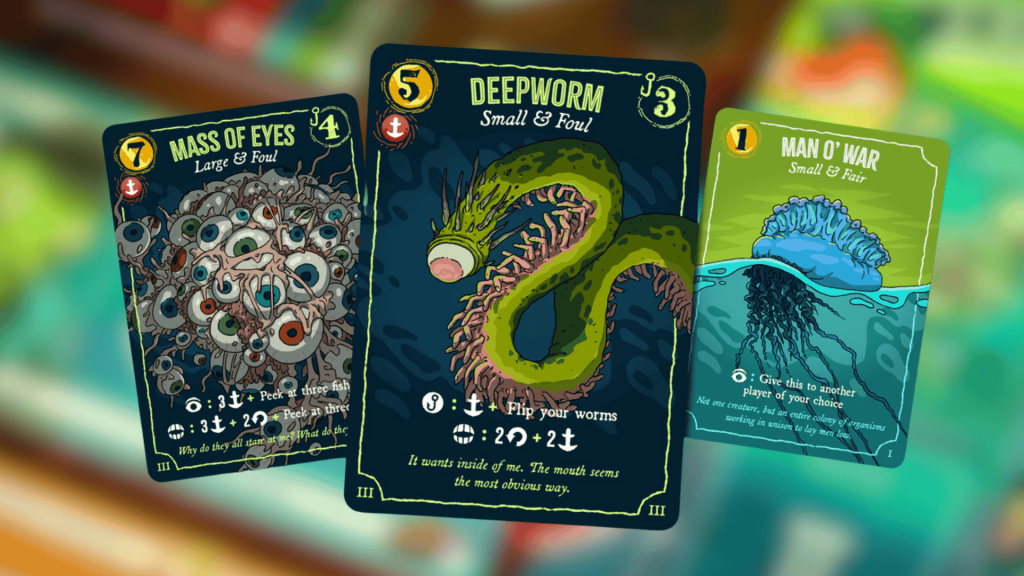
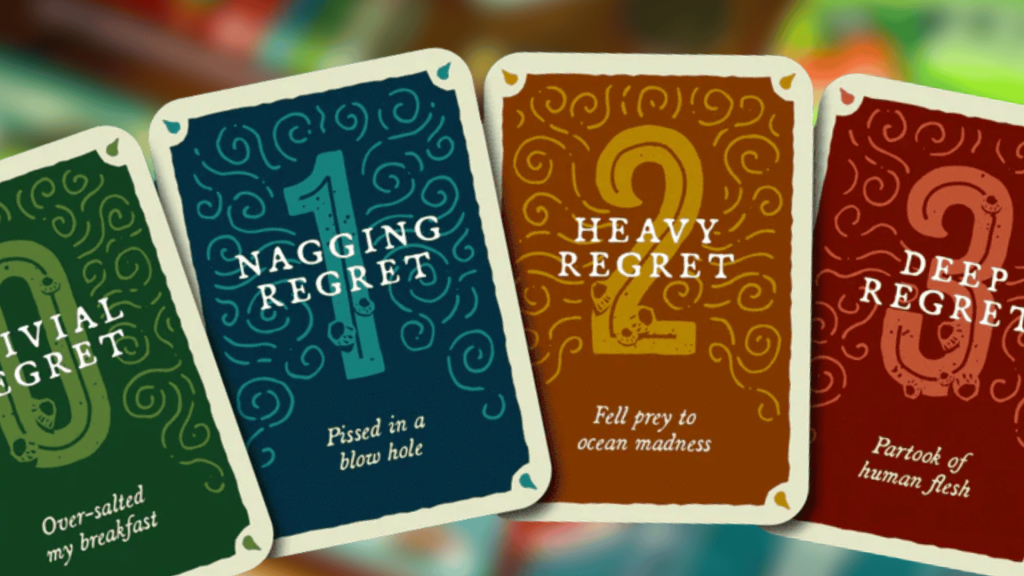
This system controls how much power players gain during the game and how badly those choices can hurt when final scoring happens.
- Regret cards are gained mostly from dangerous fish, and they stay face down, so other players never know your exact total.
- Each regret icon increases madness, which gives extra dice every turn but also changes fish prices and raises late-game penalties.
- Higher madness makes foul fish worth more money, while fair fish become cheaper, which slowly pushes players toward riskier fishing paths.
- The player with the highest total regret value at the end must discard their best mounted fish after scoring is calculated.
- Players can reduce regret by passing at port, but doing so costs time and slows income compared to aggressive fishing plans.
The goal is never avoiding regret completely, but keeping it lower than that of at least one other player when the game reaches the final day.
Scoring System And End Game Rules In Deep Regrets
The game ends after the final day, and players score points from mounted fish, fish still in hand, and remaining fishbucks.
Mounted fish usually score more, especially when bonuses apply, so choosing which fish to mount during the game matters a lot.
After scoring totals are calculated, all players reveal their regret cards and add their hidden values together for comparison.
The player with the highest total regret must discard their highest-scoring mounted fish, even if that fish carried bonuses. Winning comes from balancing steady scoring with regret control.
You want strong mounts, enough money, and regret totals that stay lower than at least one other player by the end.
Common Rule Mistakes In the Deep Regrets Board Game
Many rule mistakes happen because players assume Deep Regrets follows common board game habits, even though several systems behave differently.
These errors usually appear during turn order handling, regret penalties, or special card effects that look familiar but follow strict instructions.
1. Turn Timing And Order Issues
Passing ends the turn immediately, and the player cannot take more actions, even if they still have usable dice available.
Players must choose sea or port before spending dice, and all players reveal this choice together before any actions begin.
Once a die is spent on an action, that action fully resolves, and no other effects can interrupt, delay, or change the outcome.
2. Tie Situations And Player Conflicts
If regret totals are tied at the end of the game, the player earlier in turn order always takes the penalty.
When fish effects cause stealing, swapping, or forced actions, the active player decides the order unless a card clearly states otherwise.
Arrow symbols increase a die value step by step and never double a single die unless the card text directly explains that rule.
3. Rare Rule Situations And Exceptions
The regret penalty is applied only after all scoring is finished, and final totals are already calculated for every player.
If a mounted fish is discarded as a penalty, every bonus linked to that mount is removed immediately without replacement.
Discarded fish always go to their correct depth discard pile, and regret cards remain face down until the game fully ends.
Beginner Tips For Playing Deep Regrets Board Game
These tips help new players avoid early mistakes and understand how to pace decisions without needing multiple learning games.
- Try to keep madness in the middle range early, since too little slows progress and too much creates scoring problems later.
- Use shallow fishing early to learn card effects, then move deeper only after buying gear that helps control dice results.
- Visit the port often, because selling fish and restoring energy matter more than holding risky cards too long.
- Watch other players closely and avoid becoming the clear regret leader, since penalties punish the highest total only.
- Do not rush mounting fish, because holding flexible options can protect you if regret totals shift late.
After one complete game, the rules feel clearer, and most groups play faster while making stronger choices with less confusion.
Conclusion
Deep Regrets works best when you accept that smart choices and bad outcomes can exist together during the same turn.
I think the game shines when players stop chasing perfect plays and instead focus on timing, pressure, and watching how others manage regret.
You now know how regret shapes power, how scoring punishes extremes, and why slow control often beats fast gains at the table.
If you plan to play again, try changing your risk level, tracking other players more closely, and testing different fishing depths earlier.
With patience and practice, the game becomes easier to read, more tense, and far more rewarding each time you play.
Have you played the Deep Regrets board game yet, or are you thinking about trying it soon? Tell us and share your thoughts in the comments below.