
If you’ve ever Googled “Action Replay bricked my game” at 1:00 a.m. with sweaty palms and a cartridge clutched like it’s a newborn baby… hi. I see you.
Here’s the deal: the internet loves a good horror story. But actual, documented cases of legit cheat devices permanently killing real cartridges are weirdly rare. Most “my cart is bricked!!!” moments are really just save corruption or a temporary glitch aka your game having a dramatic little meltdown, like a Roomba getting stuck on one sock and deciding its life is over.
So before you swear off cheats forever (or, alternatively, start mashing buttons like you’re defusing a bomb), let’s talk about what “bricked” actually means, what’s actually risky, and how to not nuke your save file.
First: What People Mean When They Yell “BRICKED!”
“Bricked” gets used for, like, three different situations, and mixing them up is where the panic comes from.
1) “My cartridge is bricked”
Usually means your save data is corrupted. It feels like the cartridge died because your file won’t load and your 80-hour progress just vanished into the void. But the cartridge itself? Typically fine.
2) “My console is bricked”
That’s when the system won’t boot or function at all. Different causes, different problem. (Also a much bigger tantrum.)
3) “I got banned”
That’s an online ban. Your console still plays games offline. You just got kicked out of the online party. Annoying? Absolutely. A “brick”? Not really.
So when someone says “cheats bricked my game,” nine times out of ten they mean: something happened to the save. Not the cartridge hardware. Not the console.
So… Do Action Replay / GameShark Actually Damage Cartridges?
In general: no, not in the “your cartridge is permanently dead forever” way people love to imply.
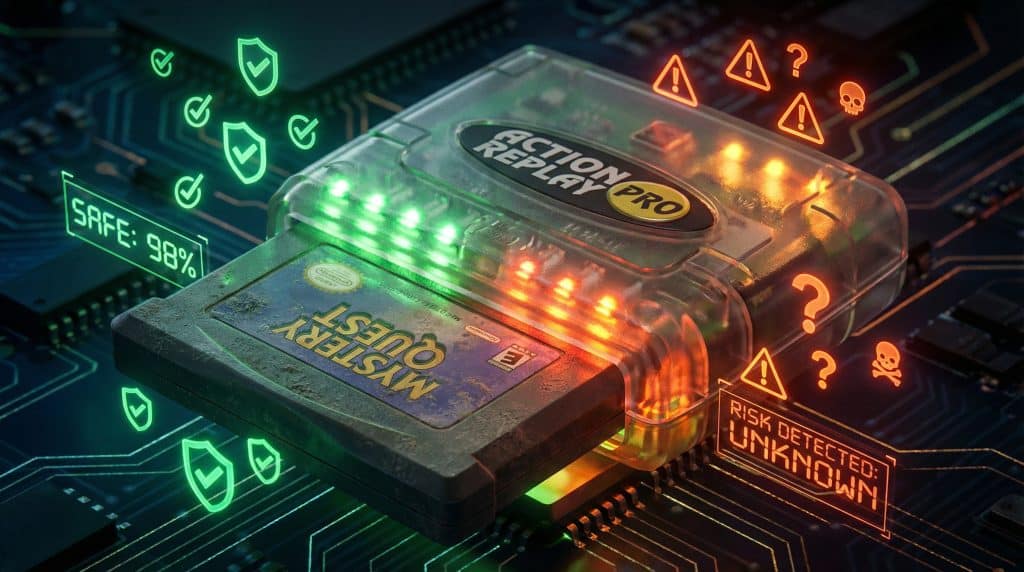
Classic cheat devices like Action Replay and GameShark are mostly RAM based they change things while the game is running, like flipping switches in the moment using a Pokemon Silver GameShark list. They typically don’t write to the cartridge’s save storage. That’s why you see a lot of scary posts… and not a lot of hard evidence of real hardware damage from legitimate units using known codes.
But (and it’s a big but): not all cheat tools behave the same way.
Cheat Devices, Ranked by “How Nervous Should You Be?”
I’m going to put these in plain English tiers, because you don’t need a computer science degree to decide if you should proceed.
Low risk: RAM only cheats (Action Replay, GameShark)
These modify what’s happening in memory while the game runs. If something goes weird, a reset usually clears it.
Most common “issue”: freezes, graphical weirdness, temporary glitches.
Most common fix: turn it off and back on (the ancient ritual).
Medium-ish risk: Game Genie (especially with funky codes)
Game Genie style stuff is generally safe with well known, well tested codes, but you can get into trouble from code format mix ups if you start using experimental codes that mess with save routines.
Rule of thumb: if the code looks like it was posted by a guy named xXShadowByteXx in 2004 with the note “untested lol”… maybe don’t.
Higher risk: Save editors / Powersaves type devices
This is the category that deserves the side eye because it writes directly to the cartridge save.
If you lose power mid write, bump the cart, or interrupt the process, your save can corrupt. Sometimes permanently.
This is where most real “I lost everything” stories come from.
Basically separate category: Flash carts (EverDrive, etc.)
These run ROMs from the flash cart itself and generally don’t mess with your original cartridges. The “it’ll fry your system with voltage” thing gets thrown around a lot, but it’s mostly theoretical compared to the very real, very boring risks above.
Red flag: Clones/counterfeit devices
Cheap knockoffs can have sloppy manufacturing and weird failure modes that legit hardware just… doesn’t. If you’re going to tinker, don’t do it with something that looks like it was assembled during a bumpy bus ride.
What Actually Causes “Cartridge Failures” (Spoiler: It’s Usually Boring)
When things go wrong, it’s rarely mysterious. It’s usually one of these:
1) Power loss or interruption during a write
This is the big one. If a device is actively writing save data and the power cuts, battery dies, or you interrupt the process, you can corrupt the save. Think of it like unplugging your computer mid update and then acting surprised it’s cranky.
2) Janky hardware / bad connection
A cartridge not fully seated, a wiggly connection, a clone device with questionable build quality… all of that can turn “quick edit” into “why is my save file empty.”
3) Rare outliers (aka: the Gateway 3DS drama)
There have been incidents (like the infamous Gateway 3DS situation) where firmware intentionally caused damage under certain conditions. That’s not “normal cheat device behavior” that’s sabotage-y nonsense. Mentioning it for context, not to feed the doom spiral.
My “Don’t Make Yourself Cry” Safety Checklist
If you’re using anything that edits saves (or might), do this. Yes, it’s a little “mom packing snacks,” but it works.
Before you start
- Back up your save. Immediately. No bargaining. (Backup first, tinker second.)
- Use stable power. Plug it in if you can don’t try to do surgery at 4% battery.
- Make sure codes/tools match your game version. Mismatches are chaos.
- Test on a throwaway save first if you can. It’s like patch testing paint before you commit to the whole wall.
- Don’t go wild with massive edits unless you’re sure the tool handles them well.
While it’s running
- Do not power off mid write. I will appear in your doorway holding a wet noodle.
- Don’t bump the cartridge. Seat it well and stop fidgeting.
- If it freezes, give it a minute before you panic shut it down sometimes it recovers.
That’s it. You don’t need a 47 step ritual. You just need to not interrupt the one moment your save is most fragile.
If Something Goes Wrong: What To Do (Without Panicking)
Most “bricks” are soft, not permanent.
If you get freezes/glitches
Restart. Seriously. If you weren’t in the middle of a save write, a reboot fixes a ton of issues.
If your save won’t load / says “corrupted”
- Have a backup? Restore it and keep living your life.
- No backup? The save may be gone. Brutal. But the cartridge itself is almost always fine the game ROM isn’t usually damaged by this kind of thing.
And yes, it stings. Losing a save feels like someone erased your diary and your childhood at the same time.
Quick Console Reality Check (Because Not All Systems Are the Same)
- Retro carts (NES/SNES/N64/GBA era): RAM only cheats are generally very low risk to the actual cartridge. The main risk is still “you did something weird to the save with a weird code.”
- 3DS: Modern custom firmware is considered hard to brick if you follow current, reputable methods and don’t interrupt installs. Also, Nintendo ended official 3DS repairs in 2025, so for true hardware issues you’re in independent repair territory.
- Switch / Switch 2: The big consequence with flash cart use tends to be online bans, not physical damage. You can still play offline, but Nintendo may permanently uninvite you from online services if you get detected.
The Bottom Line
Cheat devices, by themselves, don’t have some magical “brick ray” that permanently destroys cartridges. When people lose games, it’s usually because save data got corrupted most often from devices that write to saves (or from interruptions during that write).
If you take two habits seriously stable power and backup your save you can experiment without feeling like you’re juggling lit candles over your childhood collection.
Back it up, plug it in, use decent hardware, and go have fun bending the rules. Just don’t bend them so hard they snap your save file in half.